
[Tutorial] Building your own DIY E-Stim Stereo Device

This is the place for all suggestions, releases and feedback regarding Milovana Hardware efforts.
steelhorse545
Explorer
Explorer
Posts: 90
Joined: Wed Feb 03, 2016 11:54 am
Gender: Male
Sexual Orientation: Straight
I am a: Dom (Male)

Re: [Tutorial] Building your own DIY E-Stim Stereo Device

Post by steelhorse545 »

mantrid wrote: Tue Mar 01, 2022 10:17 pm
steelhorse545 wrote: Wed Feb 23, 2022 12:45 am The capacitor addition appears to set a low frequency cutoff (with the assumption that lower frequencies are undesirable) . In practise, the estim authors are a small number of folks -posting here or whose work is in an archive referenced in (Reddit) r/estim , so maybe it’s not a big concern, it’s a safeguard against bad actors. Omitting ie shorting)the capacitor means there’s no frequency twiddling, ie it’s a flat response.

The other feature of his addiction is some diodes to limit the voltage, not a bad idea but I’m not sure the possible failure modes of psu/amplifier warrant it. I had wondered about adding some to the electrode/output side, but without measuring voltages there it’s impossible to specify anything.

Does that make sense ? - feel free to ask :)
Sorry for the late reply. The Email notification of Milovana seems to be broken.

Together with the resistor the TVS diode limits the power. Since the the output power of the transformer cant be larger than the input power, it does not matter where the TVS diode is located except that it is easier to tailor it if it is before the transformer. For even better protection you can additional add a (poly)fuse in series to the resistor.

The capacitor also protects the transformer against DC and very low frequency currents which are transformed into heat.

The problem with the low frequencies is whether estim authors are aware of the issue and probably not whether they wanna harm you. For estim devices that re-modulate the audio signals these frequencies are neither dangerous nor unpleasant. There exist estim files that try to cause pain using low frequencies: Its reported that this feels stinging. That's a strong indication that this feeling is not just caused by directly stimulating nerves ...
Strictly speaking the TVS diode limits voltage, which results in power/current limit, but as an engineer I’m allowed to be pedantic ;) - and I’m curious about a few things you’ve mentioned..

What’s your primary design intent ? Limit in the case of amplifier(etc) failure, poorly constructed audio file, EMI effects, or something else ? (Obvs diode/clamping voltage choice will depend on which side of the transformer it’s on.)

Audio amplifiers don’t normally/ever have a non-zero quiescent/dc output or are capacitively coupled : otherwise it wastes power, plus since they’re driving loudspeaker coils then having a constant dc drive, if not undesirable for the speaker then it also limits the possible cone excursion.
Back in the dawn of time.. well, valve amplifiers :) class A amplifiers typically have an audio power transformer sitting between anode and the supply rail - there’s always a dc current. Actually, same for transistor amps, I remember drawing load lines for both. I gather there’s an effect called hysteresis distortion - maybe worth considering for audiophiles, but in this application I wonder if it’s worth worrying about.
I guess if you were driving a (linear) amp with something that was pwm- like then there might be a dc offset, whether that’s significant is another matter…but there’s probably going to be capacitive coupling into/within the amp anyway, which I suspect would limit/omit any effect.
Or have I missed something ?

mantrid
Explorer At Heart
Explorer At Heart
Posts: 166
Joined: Sun Dec 30, 2018 6:40 pm
Gender: Male
Sexual Orientation: Straight
I am a: Switch

Re: [Tutorial] Building your own DIY E-Stim Stereo Device

Post by mantrid »

steelhorse545 wrote: Sun Mar 06, 2022 5:44 pm Strictly speaking the TVS diode limits voltage, which results in power/current limit, but as an engineer I’m allowed to be pedantic ;) - and I’m curious about a few things you’ve mentioned..
To be pedantic too, I wrote:
mantrid wrote: Tue Mar 01, 2022 10:17 pm Together with the resistor the TVS diode limits the power.
Furthermore I mentioned:
mantrid wrote: Tue Mar 01, 2022 10:17 pm For even better protection you can additional add a (poly)fuse in series to the resistor.
steelhorse545 wrote: Sun Mar 06, 2022 5:44 pm Audio amplifiers don’t normally/ever have a non-zero quiescent/dc output or are capacitively coupled : otherwise it wastes power, plus since they’re driving loudspeaker coils then having a constant dc drive, if not undesirable for the speaker then it also limits the possible cone excursion.
All common amplifier classes (B, AB and D: all of them consist in something like a H-Bridge with two push-pull drivers) can deliver DC output, (Class A always as a DC offset but isn't used in prcatice.) Of course, that is never desirable for an audio amplifier and in practice that should be avoided by AC coupling the input. I would only expect DC currents that can kill the transformer in case of a malfunction. If you connect a loudspeaker you probably can live which that risk. But if your connect you crown jewels it may be worth it to spent one or two EUR/USD in extra safety.

But, to be pedantic again, I wrote:
mantrid wrote: Tue Mar 01, 2022 10:17 pm The capacitor also protects the transformer against DC and very low frequency currents which are transformed into heat.
So both, DC and low frequencies (outputting them is the aim of the amplifier) are transformed into heat which may burn the transformer and cause shortcuts. That's especially an issue for the small HF-transformers from Digikey I recommended in combination with capacitors.

Because someone wanted to use that transformer without capacitor, I felt compelled to write another warning (knowing that people don't want to hear it...)
GAsm -- A guide assembler with EStim support to generate interactive teases that run in a browser.
BoundSquirrel
Explorer At Heart
Explorer At Heart
Posts: 282
Joined: Sat Mar 15, 2014 5:07 am

Re: [Tutorial] Building your own DIY E-Stim Stereo Device

Post by BoundSquirrel »

mantrid wrote: Sun Mar 06, 2022 7:53 pm
mantrid wrote: Tue Mar 01, 2022 10:17 pm The capacitor also protects the transformer against DC and very low frequency currents which are transformed into heat.
So both, DC and low frequencies (outputting them is the aim of the amplifier) are transformed into heat which may burn the transformer and cause shortcuts. That's especially an issue for the small HF-transformers from Digikey I recommended in combination with capacitors.

Because someone wanted to use that transformer without capacitor, I felt compelled to write another warning (knowing that people don't want to hear it...)
This makes sense to me. This is the important part. Thank you.

90% of the technical talk goes over my head. I have no idea what an H-bridge is or how the conversion from AC to DC works so I'm pretty well lost there. That means that I skip most of it. Warnings in simple terms are much more easily followed - 'low frequencies and DC power can melt the small transformer which can zap your junk' is easy for us non-electrical engineers to get. :-D

In my case, I had a tiny little box working great with the transformers you recommended. I was really proud of it due to it's small size and easy of portability. And then 1 channel fried on the 3rd use. No idea what happened but I get nothing.

So, I went back to the large components in a giant box that's not going anywhere. It works just fine and apparently reduces the risk of burning up my junk. :w00t:
User avatar
edger477
Experimentor
Experimentor
Posts: 1114
Joined: Mon Nov 29, 2021 8:24 pm
Location: underfloor

Re: [Tutorial] Building your own DIY E-Stim Stereo Device

Post by edger477 »

Hey @mantrid I see you did a lot of engineering in this area, so if you would care to comment on this? If I am adding capacitor to existing midstim, aside from small signal distortion, is there any issue if using standard electrolytic ones (I have those on hand)? I am planning to try out 330uF for about 8-12 ohms in transformer + resistor?

Also, what about output? With 3-phase in theory you could have current going out from one transformer into other (because they can be phase-shifted on same frequency), would it make sense to add capacitors there (on all 4 terminals), and which ones? I think there electrolytic ones might not be suitable as voltage is higher.
My estim creations: https://mega.nz/folder/73pxmBBQ#X6ylDzRafzTt9wanZ0dacw
And in E-Stim Index: viewtopic.php?t=27090

Try creating your own estims with my restim script generator!
Spoiler: show
You can also thank me with crypto: https://trocador.app/anonpay?ticker_to= ... e+a+coffee
steelhorse545
Explorer
Explorer
Posts: 90
Joined: Wed Feb 03, 2016 11:54 am
Gender: Male
Sexual Orientation: Straight
I am a: Dom (Male)

Re: [Tutorial] Building your own DIY E-Stim Stereo Device

Post by steelhorse545 »

mantrid wrote: Sun Mar 06, 2022 7:53 pm
steelhorse545 wrote: Sun Mar 06, 2022 5:44 pm Strictly speaking the TVS diode limits voltage, which results in power/current limit, but as an engineer I’m allowed to be pedantic ;) - and I’m curious about a few things you’ve mentioned..
To be pedantic too, I wrote:
mantrid wrote: Tue Mar 01, 2022 10:17 pm Together with the resistor the TVS diode limits the power.
Furthermore I mentioned:
mantrid wrote: Tue Mar 01, 2022 10:17 pm For even better protection you can additional add a (poly)fuse in series to the resistor.
steelhorse545 wrote: Sun Mar 06, 2022 5:44 pm Audio amplifiers don’t normally/ever have a non-zero quiescent/dc output or are capacitively coupled : otherwise it wastes power, plus since they’re driving loudspeaker coils then having a constant dc drive, if not undesirable for the speaker then it also limits the possible cone excursion.
All common amplifier classes (B, AB and D: all of them consist in something like a H-Bridge with two push-pull drivers) can deliver DC output, (Class A always as a DC offset but isn't used in prcatice.) Of course, that is never desirable for an audio amplifier and in practice that should be avoided by AC coupling the input. I would only expect DC currents that can kill the transformer in case of a malfunction. If you connect a loudspeaker you probably can live which that risk. But if your connect you crown jewels it may be worth it to spent one or two EUR/USD in extra safety.

But, to be pedantic again, I wrote:
mantrid wrote: Tue Mar 01, 2022 10:17 pm The capacitor also protects the transformer against DC and very low frequency currents which are transformed into heat.
So both, DC and low frequencies (outputting them is the aim of the amplifier) are transformed into heat which may burn the transformer and cause shortcuts. That's especially an issue for the small HF-transformers from Digikey I recommended in combination with capacitors.

Because someone wanted to use that transformer without capacitor, I felt compelled to write another warning (knowing that people don't want to hear it...)
Semantics, eh ? ;)
I guess it depends on one’s frame of reference: voltage if it’s primarily to prevent transients reaching the user, power if it’s primarily to prevent high current in/fusing of the transformer in a fault condition.

The short answer I was mainly looking for : in the event of an amplifier/psu fault driving dc into the transformer, fusing it and any unwanted effects downstream.
I suspect that for many of the transformers I’ve seen listed - ie 10W - low freq heating in the transformer isn’t likely to be much of a concern, but I guess it subtracts from any power handling headroom with the small ones you’re using (aside from any undesirable effects on the user).
Edit : Not sure how one would work out the power rating for any TVS diode since it’s an unexpected fault condition and the current could be sustained, but I guess that’s where adding a fusible component would fit in.
Thanks for the reply.
InfamousPlantain
Explorer
Explorer
Posts: 84
Joined: Thu Apr 12, 2018 1:41 am

Re: [Tutorial] Building your own DIY E-Stim Stereo Device

Post by InfamousPlantain »

Hi All, been following the latest few posts and as I lurk on this and other threads, it occurred to me that people are setting up modifications in the same spot. I'm hoping someone can help explain the purpose of the parallel resistor method found here: viewtopic.php?p=283515#p283515 ? How does it compare to the low pass filter method here? Does the parallel resistor method offer any protection at all?

It sounds like the low pass filter is more of a safety thing but the parallel resistor is just an improvement on the feeling thing? Is it possible to use both methods? Thanks!
User avatar
edger477
Experimentor
Experimentor
Posts: 1114
Joined: Mon Nov 29, 2021 8:24 pm
Location: underfloor

Re: [Tutorial] Building your own DIY E-Stim Stereo Device

Post by edger477 »

InfamousPlantain wrote: Tue Mar 08, 2022 6:18 pm

It sounds like the low pass filter is more of a safety thing but the parallel resistor is just an improvement on the feeling thing? Is it possible to use both methods? Thanks!
Hi, those two are "orthogonal" concepts - meaning they are not interfering with each other, but additional resistor in parallel with transformer increases "load" through capacitor so cutoff value might be moved to higher frequency or you might need larger capacitor, but I forgot hot to calculate those... college was long ago, and even if I google the formula, I am not sure below what frequency I want to filter out so research/testing is necessary 8-)

Anyway, parallel resistor can be used with capacitor... it is just additional load on amplifier that ensures amplifier works, as some transformers have too low resistance when there is no signal, there might be no output from amplifier on low volume (amplifier does not sense that speaker is connected), then suddenly you get zapped when you increase volume above threshold where transformer becomes actual load and amplifier "wakes up". I would guess that lack of parallel resistor can also cause signal to feel very "spiky" and unpleasant with small transformers if their resistance is going outside amplifier's design.

I have 2 midstim boxes now, one with and one without parallel resistors and I don't see significant difference, but I use large ELA-T10 transformers from Conrad that already have 4 Ohms of static resistance.

This parallel resistor also makes the voltage on the output less dependent on the load connected (basically you have less voltage drop when you use electrodes with larger surface area), might be useful for some scenarios, i.e. if you make venus/tremblr receiver lined with conductive rubber, so your electrode surface area is variable.
My estim creations: https://mega.nz/folder/73pxmBBQ#X6ylDzRafzTt9wanZ0dacw
And in E-Stim Index: viewtopic.php?t=27090

Try creating your own estims with my restim script generator!
Spoiler: show
You can also thank me with crypto: https://trocador.app/anonpay?ticker_to= ... e+a+coffee
InfamousPlantain
Explorer
Explorer
Posts: 84
Joined: Thu Apr 12, 2018 1:41 am

Re: [Tutorial] Building your own DIY E-Stim Stereo Device

Post by InfamousPlantain »

I see.. that does clear things up a little. Thanks!
mantrid
Explorer At Heart
Explorer At Heart
Posts: 166
Joined: Sun Dec 30, 2018 6:40 pm
Gender: Male
Sexual Orientation: Straight
I am a: Switch

Re: [Tutorial] Building your own DIY E-Stim Stereo Device

Post by mantrid »

edger477 wrote: Tue Mar 08, 2022 1:10 pm Hey @mantrid I see you did a lot of engineering in this area, so if you would care to comment on this? If I am adding capacitor to existing midstim, aside from small signal distortion, is there any issue if using standard electrolytic ones (I have those on hand)? I am planning to try out 330uF for about 8-12 ohms in transformer + resistor?
330µF are okay. Cuttoff frequency (-3 db, about 30% reduction of voltage) would be about 110 Hz. I would use 100µF (cutoff frequency about 350 Hz),

You have to use a bipolar audio capacitors with a voltage of at least 16V (if amplifier is powered with 12V). Normal unipolar electrolytic capacitors won't work.
edger477 wrote: Tue Mar 08, 2022 1:10 pm Also, what about output? With 3-phase in theory you could have current going out from one transformer into other (because they can be phase-shifted on same frequency), would it make sense to add capacitors there (on all 4 terminals), and which ones? I think there electrolytic ones might not be suitable as voltage is higher.
Not required. In 3(or more)-phase setup current between the electrodes is mixture of the two input signals. If these signals contain no low frequency competents, such components cannot appear is the mixed signals.
steelhorse545 wrote: Tue Mar 08, 2022 4:04 pm Semantics, eh ? ;)
I guess it depends on one’s frame of reference: voltage if it’s primarily to prevent transients reaching the user, power if it’s primarily to prevent high current in/fusing of the transformer in a fault condition.
Schematic is there: viewtopic.php?p=288013#p288013

Power that reaches the transformer is U*I=U^2/R. Thus, if R>0 and U is limited, power is limited. Peak pulse power dissipation of the 1.5K... TVS diodes I use is 1.5kW. In order the withstand continuous over voltages a fuse should be added in series to the resistor (not in the schematic because that idea was stolen later from someone in this thread or in this forum)
InfamousPlantain wrote: Tue Mar 08, 2022 6:18 pm I'm hoping someone can help explain the purpose of the parallel resistor method found here: viewtopic.php?p=283515#p283515 ? How does it compare to the low pass filter method here? Does the parallel resistor method offer any protection at all?

It sounds like the low pass filter is more of a safety thing but the parallel resistor is just an improvement on the feeling thing? Is it possible to use both methods? Thanks!
edger477 already answered it. Just a few additions.

Of course, the parallel resistor wont change how current stimulates the neurons, but there are some side effects.
  1. Parallel resistor makes the output less current controlled and more voltage controlled. That can also be achieved by choosing a lower series resistor value of by choosing a smaller winding ratio (I would go the latter way). Whether the estim signal is current controlled or voltage controlled matters when the contact surface changes. With current control reduction of the contact surface can cause high voltages and high current densities which can feel stinging. With voltage control the opposite happens: The signal feels less intense if the contact surface is reduced. If you experience that problems, you should change you electrode setup.
    • Electrode surface should be as large as possible
    • Contact resistance should be as low ass possible (use salted water based lube)
    • Resistance of the electrode should be low. Thats relevant for conductive rubber which has a quiite large resistance. If that material is used, it should have something like a metal core.
  2. Parallel resistor can cause clipping if the amplifier cant deliverer enough output power. In that case increasing volume has less effect and (harsh) signals that play with volume variation become less harsh.
  3. In 3-phase setups signals are mixed differently. But it's IMHO impossible to predict whether this feels better or worse.
Both concepts, parallel resistor and hi-pass filter can be combined. It does not matter where the parallel resistor is located, before the capacitor, behind the capacitor or even behind the transformer (in that case you need to increase the resistor value.)
GAsm -- A guide assembler with EStim support to generate interactive teases that run in a browser.
InfamousPlantain
Explorer
Explorer
Posts: 84
Joined: Thu Apr 12, 2018 1:41 am

Re: [Tutorial] Building your own DIY E-Stim Stereo Device

Post by InfamousPlantain »

@mantrid, wow. that's splendid information. Thanks! took me a few reads to digest it.
User avatar
edger477
Experimentor
Experimentor
Posts: 1114
Joined: Mon Nov 29, 2021 8:24 pm
Location: underfloor

Re: [Tutorial] Building your own DIY E-Stim Stereo Device

Post by edger477 »

mantrid wrote: Tue Mar 08, 2022 10:22 pm
You have to use a bipolar audio capacitors with a voltage of at least 16V (if amplifier is powered with 12V). Normal unipolar electrolytic capacitors won't work.
I have read on some electronic forums that connecting 2 standard capacitors in series (cathodes together) is okay-ish equivalent of bipolar capacitor (might not be perfectly balanced due to capacitors not being 100% identical). I will try using 50V/100uF ones in my box before I order the expensive audio ones.
My estim creations: https://mega.nz/folder/73pxmBBQ#X6ylDzRafzTt9wanZ0dacw
And in E-Stim Index: viewtopic.php?t=27090

Try creating your own estims with my restim script generator!
Spoiler: show
You can also thank me with crypto: https://trocador.app/anonpay?ticker_to= ... e+a+coffee
mantrid
Explorer At Heart
Explorer At Heart
Posts: 166
Joined: Sun Dec 30, 2018 6:40 pm
Gender: Male
Sexual Orientation: Straight
I am a: Switch

Re: [Tutorial] Building your own DIY E-Stim Stereo Device

Post by mantrid »

edger477 wrote: Wed Mar 09, 2022 9:02 pm I have read on some electronic forums that connecting 2 standard capacitors in series (cathodes together) is okay-ish equivalent of bipolar capacitor (might not be perfectly balanced due to capacitors not being 100% identical). I will try using 50V/100uF ones in my box
This is how bipolar electrolytic capacitors are made. If you hear a shot it didn't worked: Bipolar electrolytic capacitors need a thicker dielectric because it must withstand the "wrong" polarity for a short time. If it is to thin a shortcut occurs and the capacitor explodes.
edger477 wrote: Wed Mar 09, 2022 9:02 pm before I order the expensive audio ones.
That investment will cost less than 1 EUR, see the partlist
GAsm -- A guide assembler with EStim support to generate interactive teases that run in a browser.
Neamcrain
Curious Newbie
Curious Newbie
Posts: 1
Joined: Fri Mar 18, 2022 11:08 pm

Re: [Tutorial] Building your own DIY E-Stim Stereo Device

Post by Neamcrain »

Hello guys, new to this forum but:

TL;DR;
Long time e-stimmer, thought it would be time to upgrade my professional medical grade devices to a custom build one.
Image

Didn't thought it would be as easy and cheap as it was.

Also I wanted to thank everyone in here for the blueprints that made it that easy!
User avatar
lolol2
Explorer At Heart
Explorer At Heart
Posts: 518
Joined: Mon Feb 20, 2017 10:33 am
Gender: Male
Sexual Orientation: Straight

Re: [Tutorial] Building your own DIY E-Stim Stereo Device

Post by lolol2 »

Hey guys,
after my AMP stopped working a few weeks ago I build me a new device and added some recommendation from the thread (thanks to all the input!) in the new build. So here is an additional example, lets call it my v2 version.

Same like last time, this isn't the easiest or cheapest way of building a DIY device, but I guess it's always nice to have a few different designs as example which work well. Basic soldering skills needed!

Lets start with the shoping list to german sellers where you can get all the needed stuff.
I cannot provide any links for other countrys but I guess the most stuff you will also find in your country.

1x Case (BAHAR ABS Enclosure) - 18.10€
2x 100V transormers (same like in V1) - 18.98€
1x AMP Board 2x 50W@12V or 2x 120W@24V - 10.99€
2x 10k Ohm Pots (Box set) - 8.99€
4x Ports for electrodes (Box set) - 8.50€
2x 3.9 Ohm 50W resistors - 6.98€
2x 22 Ohm 50W resistors - 6.89€
1x Power switch with 3x In/Output - 5.99€
1x Power switch with 1x In/Output for triphase - 4.90€
1x Power socket 4.46€
2x Chinch Input (red) (black) (white) - 6.07€
1x 5m 0.5mm² cables, pick different colours - ~2.50€

1x 12V power supply - 29.99€ (personally recommended)
Looks like Leicke changed there production and this one isn't anymore a class 2!

Optional for electrode, with those simple 3 things you can build a lot of cables for different setups:
10x 2pin cabels for having enough 2pin connector - 11.92€
40x Banana 4mm pins (Box set) - 9.50€
1x 25m thin speaker cables - 8.49€
1x 2m silicon loop - 12.99€ (I can personally recommend this seller)

Lub I can personaly recommend which is very conductive, don't smell and don't dry out very fast
1x Chaps Gleitgel - 5.65€


Here is the diagram how everything is connected, like last time -> right click -> view picture (for better resolution)

Image

Notes:
1) I have switched to 3.9 Ohm resistors before the transformers and also added a 22 Ohm restistor in parallel to each transformer like recommended in another thread.
The result is a very clean and dry feeling of the signal, I really like it, the v1 device was already good but this is a bit smoother.

2) I have routed the output over the power switch for both channels, this prevent to have any not wanted AMP noices which can appear when you turn of the power. This is more a safty feature I wanted to have, when you switch off the device, you also cut you off from the electrodes. I have experienced this with the listed AMP, so I would recommend to add this switch.

3) I use the AMP at 12V and this thing is VERY powerful! I don't know the max volume because I didn't maxed it out yet.
The v1 version I did max out a few times with big electrodes, this thing is even more powerful and seems like have no heat problem. Would recommend to start with a 12V power supply and only switch to the 24V version if you max it out.
On your own risk of course. :innocent:

Like last time, take care to take a double insulated one, my links are save to use.
Watch out for this sticker on your power supply.
Image

4) I really like this case even if it's hard to fit everything inside.
There are also bigger versions if you want to be on the safe site but I really like and can recommend the 140 x 170 x 60 mm version.

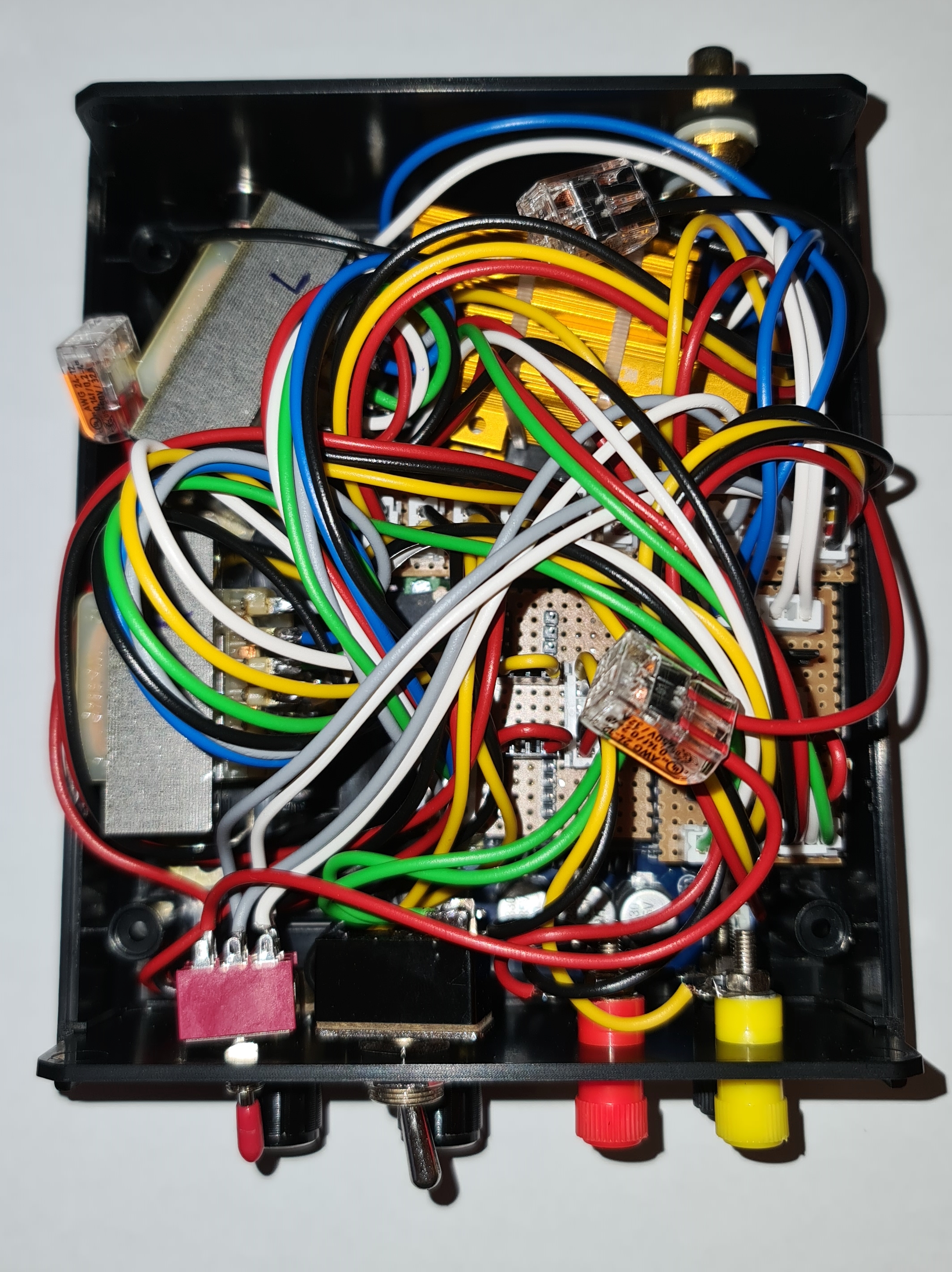
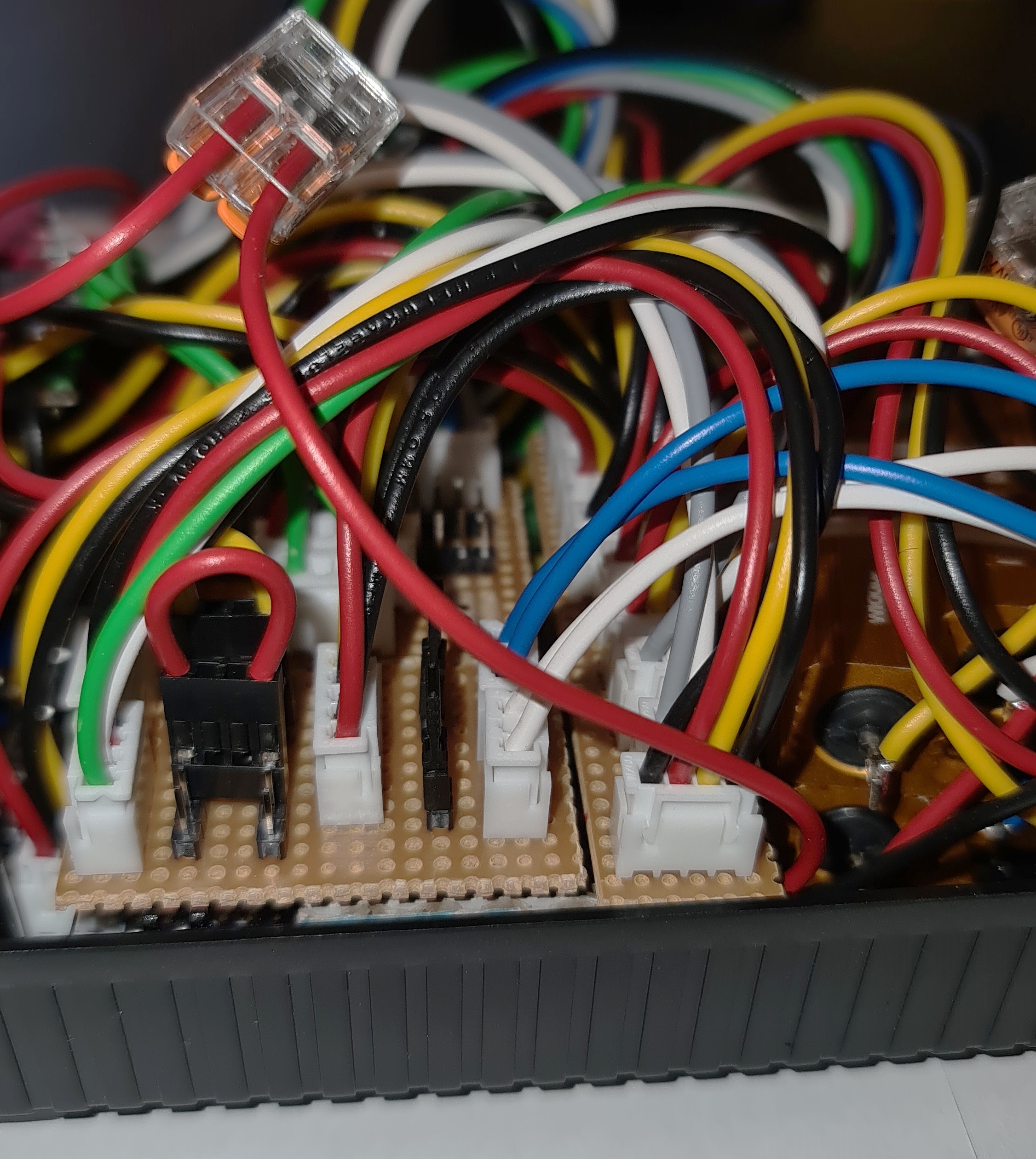
5) I have connected everything to a kind of connection board with socket, plugs and jumpers to test around a bit with different transformers ratios. Of course this is not needed, you can follow my connection plan and only connect everything that is needed, this will remove a lot of the mess in my pictures because you only need 1/4 of the cables.
The shown transformer ratio is 15:1 which seems to work pretty good.

6) I would recommend to not touch the volume knobs on the AMP itself, let them in the same position like shown in the diagram. Set your output from PC, phone, whatever to 90-100%.

Here are some pictures:

Image

Image

Image

Image


Like always, if you have any questions, feedback or recommendations just add everything here.
I'm not an expert in electronic stuff and also learned about estim build from sources like this forum.
I can also provide my working example which I really like and could be build with basic electronic and soldering skills.

Costs should be around 150€ with shipping for all parts + the stuff for electrodes.
Still cheaper and a lot more powerful and flexible to use than all the commercial devices. :wave:
Last edited by lolol2 on Mon Mar 20, 2023 9:04 am, edited 3 times in total.
My creations:
Spoiler: show

[Tutorial] Building your own DIY E-Stim Stereo Device

Videos:
06/2020 - Estim Sync Hero Vol. 01

Teases:
04/2020 - Estim Mansion under Quarantine
12/2019 - Estim Challenge
12/2018 - Estim Distraction
03/2018 - The Estim Tower - Endless Mode
01/2018 - The Estim Tower
05/2017 - The Estim Mansion
Spielers
Explorer At Heart
Explorer At Heart
Posts: 309
Joined: Mon Jan 09, 2017 8:26 pm
Gender: Male
Sexual Orientation: Straight
I am a: Submissive

Re: [Tutorial] Building your own DIY E-Stim Stereo Device

Post by Spielers »

lolol2 wrote: Sat May 21, 2022 7:37 pm
Here is the diagram how everything is connected, like last time -> right click -> view picture (for better resolution)

Image
Why don't you connect the transformer to 0Ohm and 4Ohm and to 0W and 0,65W?
If you connect to 0,65W you have lower Amper and higher Voltage, and we want very low Amper.
Last edited by Spielers on Tue May 24, 2022 6:40 am, edited 1 time in total.
Post Reply