[Tutorial] Building your own DIY E-Stim Stereo Device

This is the place for all suggestions, releases and feedback regarding Milovana Hardware efforts.
darthjj
Explorer At Heart
Explorer At Heart
Posts: 134
Joined: Wed Jun 16, 2021 6:42 am

Re: [Tutorial] Building your own DIY E-Stim Stereo Device

Post by darthjj »

wmounted wrote: Tue Mar 19, 2024 11:46 am What software do you use ?

I measured the electrode output voltage with a multimeter while an estim file is playing. The voltage fluctuated between ~60V and 1500V. As far as I understand, voltages of estim frequencies can't be accurately measured with a multimeter. The datasheet of the multimeter says: Frequency response: 45-400Hz (not sure if it can measure the voltage accurately even within this range when frequency consistently changes).

How did you measure the current? Is it by connecting the multimeter in series with one of the electrodes?
Sounds like you've made some progress, but just to answer your questions;

For testing or debugging, I usually use this tone generator: https://www.szynalski.com/tone-generator/

The voltmeter I have shows a stable value for higher frequencies when set to AC mode, and from reading online I believe the displayed number can be a little bit off when used with other frequencies than 50-60Hz but still close enough to get a rough measurement. Might be different for different devices.

I measured both voltage (though peak-to-peak) and current using an old analogue oscilloscope. For the latter I put a low ohm resistor with a heatsink into the loop and measured the voltage drop over it, since my oscilloscope can't measure current directly.

In your other comment you wrote that you got blisters when using some loops, right? Was this with conductive rubber (CR)? Common CR contains nickel particles, so it could be an allergic reaction if you're sensitive to Ni. There's also CR with carbon particles, but it has much lower conductivity. And there's CR with silver or gold particles, but that makes it much more expensive instead.
darthjj
Explorer At Heart
Explorer At Heart
Posts: 134
Joined: Wed Jun 16, 2021 6:42 am

Re: [Tutorial] Building your own DIY E-Stim Stereo Device

Post by darthjj »

diglet wrote: Mon Jan 08, 2024 8:11 am
JakofClubs wrote: Sun Jan 07, 2024 3:49 pm
edger477 wrote: Fri Jan 05, 2024 7:10 pm

Actually, I did not research myself, I suspected that the reason for them might have been that older amps did not pump current until they detect some minimum load, and asked about it in Joanne's discord (there are some very good electronics engineers there). On modern amps, especially with a transformer that has static resistance (when you measure with Ohmmeter) that is 4 or 8 Ohms (the side we connect to amp), these parallel resistors are just waste of power, and also source of unnecessary heat.
My mistake. Perhaps it was Diglet that did the testing?
I did some testing with a tpa3116 clone, scope and parallel resistor, was not able to identify any useful effects.

Tests available here: https://github.com/diglet48/restim/wiki ... l-resistor
I just found those pages on your wiki, and it completely overthrows my leading theory of why some people were perceiving carrier frequency changes as changes in signal intensity while others weren't. Well, back to the drawing board.. Appreciate the thorough testing!
diglet
Explorer At Heart
Explorer At Heart
Posts: 390
Joined: Sun Dec 11, 2022 5:43 pm

Re: [Tutorial] Building your own DIY E-Stim Stereo Device

Post by diglet »

darthjj wrote: Wed Apr 17, 2024 10:02 am
I just found those pages on your wiki, and it completely overthrows my leading theory of why some people were perceiving carrier frequency changes as changes in signal intensity while others weren't. Well, back to the drawing board.. Appreciate the thorough testing!
FWIW my theory is that this is caused by a relationship between skin resistance and frequency. Suppose we have skin resistance 500ohm at 500hz and 200ohm at 1000hz, then increasing the frequency causes a (more than double) increase in current.

But the box also has internal resistance, which may be 100ohm or 500ohm, also affected by the winding ratio, presence of parallel resistor, and electrode quality. The lower the internal resistance of your stimbox, the more the current increases as the frequency increases (due to lower skin resistance).

The tests I linked earlier show that the internal resistance of the box is mostly independent of frequency

I investigated the dependency between skin resistance and frequency here: https://github.com/diglet48/restim/wiki/skin-resistance
And the dependency between current, frequency and nerve activation here: https://github.com/diglet48/restim/wiki ... activation
darthjj
Explorer At Heart
Explorer At Heart
Posts: 134
Joined: Wed Jun 16, 2021 6:42 am

Re: [Tutorial] Building your own DIY E-Stim Stereo Device

Post by darthjj »

diglet wrote: Thu Apr 18, 2024 4:34 pm
darthjj wrote: Wed Apr 17, 2024 10:02 am
I just found those pages on your wiki, and it completely overthrows my leading theory of why some people were perceiving carrier frequency changes as changes in signal intensity while others weren't. Well, back to the drawing board.. Appreciate the thorough testing!
FWIW my theory is that this is caused by a relationship between skin resistance and frequency. Suppose we have skin resistance 500ohm at 500hz and 200ohm at 1000hz, then increasing the frequency causes a (more than double) increase in current.

But the box also has internal resistance, which may be 100ohm or 500ohm, also affected by the winding ratio, presence of parallel resistor, and electrode quality. The lower the internal resistance of your stimbox, the more the current increases as the frequency increases (due to lower skin resistance).

The tests I linked earlier show that the internal resistance of the box is mostly independent of frequency

I investigated the dependency between skin resistance and frequency here: https://github.com/diglet48/restim/wiki/skin-resistance
And the dependency between current, frequency and nerve activation here: https://github.com/diglet48/restim/wiki ... activation
I also brought out the old, almost antique, oscilloscope today and ran a bunch of tests. It's analogue so there's of course a fair bit of measurement error everywhere. And I had to add a 100Ohm resistor in series with the body since I don't own a proper current probe, I hope this didn't influence the measurements. The currents I measured were a bit higher than I had expected, but I think I got the maths right..

I could confirm that the parallel resistor doesn't change how frequency translates to perceived intensity, by trying to locate subjective levels (minimum noticeable power, light tease, pleasure, intense pleasure, and pain) and then comparing the current logged at each point. Accounting for the subjective error margin, values were more or less identical with and without the parallel resistor.

One thing that surprised me a little was how much more current was needed for each "level" after having gone all the way up to where it starts getting painful. When starting at 0 and slowly increasing power, I found the (light tease, pleasure, intense pleasure) currents at (32.5mA, 40mA and 50mA) and finally hitting the pain threshold at 80mA. Staying there only a few seconds before performing the reverse process, I now found the same levels at (50mA, 65mA and 75mA), and it seemed the tolerance remained as long as any signal was present. After I rested for 30 seconds with no signal the sensitivity was almost fully restored. Obviously I was aware of this effect, but I didn't expect the differences to be so large and that it built up so quickly.

With a little bit of "warm up", I've found these approximate relations between current and subjective intensity at 1000Hz:
  • 20-30mA just barely noticeable
  • 30-40mA light tease
  • 40-50mA pleasure
  • 50-80mA intense pleasure
  • 80mA+ pain
Perhaps not useful for anything but I found it a little interesting that the range for what I would label as intense pleasure was so wide compared to the others. Though I suppose that's a question about definitions..

I also calculated body resistance by measuring current and voltage drop over the electrodes at the same time. Used a stainless steel head 'trode, approx 20cm², with electrode gel and a wet cloth loop around the balls, approx 15cm², I think I got similar values to yours though a little lower, perhaps due to the larger contact areas. With 1000Hz I got 740Ohm at 20mA, 643Ohm at 40mA, 594Ohm at 60mA and 507Ohm at 80mA.

Now here's the interesting thing, I did not get significantly different resistances at different frequencies. I set the current to 60mA, the signal generator to 1000Hz and measured 32V over the electrodes. Then I increased the frequency to 1500Hz, the current stayed the same and the voltage dropped down to 30V. I increased the freq. to 2000Hz and I could see that it dropped another 2V, but not to 28V.. it looked more like 30V.. almost 31, which confused me a lot. So I turned frequency down instead, and I could see the voltage jumping up each time, but somehow the voltage always stayed in the 30-34V range. Looking more closely at the 'scope, it seemed like the voltage always crept back towards around 32V peak-to-peak regardless of frequency, though very slowly, on the scale of tens of seconds. Wish I had a better oscilloscope so I could provide definite numbers instead of having to eyeball it.

Going back to my subjective intensity measurements, I tried to find each "level" for 700, 1000 and 1500Hz. It seemed like each freq. increase required an additional 5mA to reach the same level, i.e. "mild tease" hit at 32.5mA at 700Hz, 37.5mA at 1000, and 42.5 at 1500. It also seemed fairly consistent at all levels. Though it's hard to say how accurate this is accounting for subjectivity, measuring error and tolerance buildup.

diglet
Explorer At Heart
Explorer At Heart
Posts: 390
Joined: Sun Dec 11, 2022 5:43 pm

Re: [Tutorial] Building your own DIY E-Stim Stereo Device

Post by diglet »

All of that matches my experience. With some warmup I reliably cum at 70-85mA 700hz at the head. Pain tolerance is much lower for butt area, I give up at around 33mA 700hz continuous, or 48mA with a slow on-off signal.

I also noticed testing skin resistance at different frequencies is quite difficult. I had most success with a current controlled setup, using volume dial and scope to manually control the current between signals. There are many nonlinearities involved, I even discovered some drift over time due to the electrogel 'settling in'. I also noticed significant differences between electrode materials.
darthjj
Explorer At Heart
Explorer At Heart
Posts: 134
Joined: Wed Jun 16, 2021 6:42 am

Re: [Tutorial] Building your own DIY E-Stim Stereo Device

Post by darthjj »

Not sure if I've mentioned it before but I did a lot of experiments with pulsed signals a few years ago and found that there was no significant difference between a pulse followed by a "silent" period and a continuous pulse train (or sine wave etc). I think this is similar to what you're doing with pulse mode in restim? I haven't had time to look into the code much

Based on this I tried to find some algorithm to measure signal intensity, since the avereage amplitude/integral or RMS doesn't take frequency into account. I came up with an algoritm with finds the largest pulse within a small time period, and then plotted those ticks. I thought it was fairly accurate, but now I'm trying to recreate the results and I think it weights low freq signals too heavily.

I kind of suspect that I might have got less "signal sensitive" with the years. In the beginning I thought going down a few 100hz made the signal almost painful but now it barely feels like an intensity increase. That might've contributed to that I thought my old box, without parallel resistors was different
diglet
Explorer At Heart
Explorer At Heart
Posts: 390
Joined: Sun Dec 11, 2022 5:43 pm

Re: [Tutorial] Building your own DIY E-Stim Stereo Device

Post by diglet »

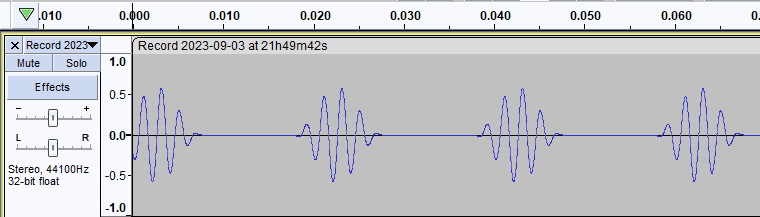
Pulse based mode generates signals like this:
Image

Ignoring repetitive stimulus, the signal intensity is defined by the integral of delivered charge over a small time period. The wiki has the exact equations, it is not quite linear, if you simply calculate the charge per pulse you will over-estimate the intensity of low-frequency signals.

The impact of repetitive stimulus is quite small. One source states that If you stimulate for 3 carrier cycles instead of just one you'll generate 'only' 10% more nerve activation. Haven't been able to find the exact equations... but it's pretty clear continuous signals are not what you want.
FuFuFan69
Explorer
Explorer
Posts: 5
Joined: Thu Apr 25, 2024 7:04 pm

Re: [Tutorial] Building your own DIY E-Stim Stereo Device

Post by FuFuFan69 »

Building my own box based on the schematic on page 12. I found a card that has jackstick and bluetooth connections. It seemed decent. Issue is, I just realized the pots go on the input side of things rather than the output, and that's not possible unless I desolder the jackstick and somehow add them between there, that also doesn't work with the bluetooth side that I thought would be less of a hassle to use.

Would it be problematic if I put the pots between the transformer output and the banana plugs?

I also bought the original XH-M543(rather than one of the copies that seem to be everywhere) - But I'd much prefer the other card because of the bluetooth.
diglet
Explorer At Heart
Explorer At Heart
Posts: 390
Joined: Sun Dec 11, 2022 5:43 pm

Re: [Tutorial] Building your own DIY E-Stim Stereo Device

Post by diglet »

FuFuFan69 wrote: Thu Apr 25, 2024 7:18 pm Would it be problematic if I put the pots between the transformer output and the banana plugs?
Yes. This will fry the pots immediately.
darthjj
Explorer At Heart
Explorer At Heart
Posts: 134
Joined: Wed Jun 16, 2021 6:42 am

Re: [Tutorial] Building your own DIY E-Stim Stereo Device

Post by darthjj »

FuFuFan69 wrote: Thu Apr 25, 2024 7:18 pm Building my own box based on the schematic on page 12. I found a card that has jackstick and bluetooth connections. It seemed decent. Issue is, I just realized the pots go on the input side of things rather than the output, and that's not possible unless I desolder the jackstick and somehow add them between there, that also doesn't work with the bluetooth side that I thought would be less of a hassle to use.

Would it be problematic if I put the pots between the transformer output and the banana plugs?

I also bought the original XH-M543(rather than one of the copies that seem to be everywhere) - But I'd much prefer the other card because of the bluetooth.
Never heard the term jackstick before, but you mean a 3.5mm audio jack, right? In that case you can build a volume box which also has a stereo audio jacks input and output, and connect it to the amplifier using a standard audio cable. This is how I added per-channel volume controls to my box.
FuFuFan69
Explorer
Explorer
Posts: 5
Joined: Thu Apr 25, 2024 7:04 pm

Re: [Tutorial] Building your own DIY E-Stim Stereo Device

Post by FuFuFan69 »

darthjj wrote: Mon Apr 29, 2024 9:17 am Never heard the term jackstick before, but you mean a 3.5mm audio jack, right? In that case you can build a volume box which also has a stereo audio jacks input and output, and connect it to the amplifier using a standard audio cable. This is how I added per-channel volume controls to my box.
That is what I meant, local term is jackstick, didn't think to use 3.5mm audio jack. Thanks for the suggestion, I considered doing it that way, but decided to just redo the box with XH-M543 as the brains. :)
User avatar
Afapp
Explorer At Heart
Explorer At Heart
Posts: 308
Joined: Thu Dec 07, 2017 6:46 pm
Gender: Male

Re: [Tutorial] Building your own DIY E-Stim Stereo Device

Post by Afapp »

I have just completed another stim box. It uses an old breeze audio 3116 amp. 2 linear pots for l+r volume control. RCA plugs for input, banana jacks for output. 3.9 ohm resistors on the + side in series between the amp and the specko new transformers. I’m using the 0.5w tap on the transformers. Here’s a couple of pics of the front panel build. I’ll post more spaghetti final pics later.
Unnamed7edit.jpg
Unnamed7edit.jpg (355.76 KiB) Viewed 6778 times
unnamed5edit.jpg
unnamed5edit.jpg (750.96 KiB) Viewed 6778 times
unnamed3edit.jpg
unnamed3edit.jpg (774.74 KiB) Viewed 6778 times
unnamed1edit.jpg
unnamed1edit.jpg (391.14 KiB) Viewed 6778 times
User avatar
Visitor from Bound Anna
Explorer At Heart
Explorer At Heart
Posts: 173
Joined: Mon Apr 08, 2024 11:16 pm
Sexual Orientation: Straight
Contact:

Re: [Tutorial] Building your own DIY E-Stim Stereo Device

Post by Visitor from Bound Anna »

I love it! It's simply awesome!
Image
User avatar
Afapp
Explorer At Heart
Explorer At Heart
Posts: 308
Joined: Thu Dec 07, 2017 6:46 pm
Gender: Male

Re: [Tutorial] Building your own DIY E-Stim Stereo Device

Post by Afapp »

as promised. I'm not to tidy with wires. Box works great, most stim levels between 11:00 and 1:00 on the master volume.
finished1edit.jpg
finished1edit.jpg (768.21 KiB) Viewed 6580 times
Finished2edit.jpg
Finished2edit.jpg (696.37 KiB) Viewed 6580 times
Finished3edit.jpg
Finished3edit.jpg (718.41 KiB) Viewed 6580 times
Finished4edit.jpg
Finished4edit.jpg (648.61 KiB) Viewed 6580 times
Finished5edit.jpg
Finished5edit.jpg (877.49 KiB) Viewed 6580 times
trodes
trodes
IMG_3046.jpg (241.37 KiB) Viewed 6580 times
Roberto9.99
Curious Newbie
Curious Newbie
Posts: 1
Joined: Mon Jul 01, 2024 1:35 pm

Re: [Tutorial] Building your own DIY E-Stim Stereo Device

Post by Roberto9.99 »

I was thinking on trying to wire up the V2, and wanted someone to check if I understood the schematics correctly, before I solder it all together. Is the wiring painted on the photo correct? https://ibb.co/QQfTtjz
Post Reply