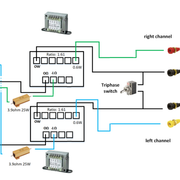

In the standard 3phase setup with 1kHz sinusoidal calibration signal I measured electrode currents of 35mA and 12mA at electrode impedance's of 100 Ohm and 270 Ohm.
I attached a spread sheet (created with gnumeric) which can be used to dimension the parts.
Remarks/usage hints:
- Transformer data (DC resistance of the windings and winding ratio) should be entered in rows 1 to 4
- Rows 5 and 6 depend on electrode setup. Based on my measurements the estim box should be able to drive 50mA @ 500 Ohm (which should contain sufficient margin)
- Rows 7 and 8 contain values of series resistor and capacitor
- Remaining rows are calculated data. Voltages and currents are effective values (0.707 times the peak values). Power values are average values. Calculations are correct if magnetic loss and impedance of the capacitor are neglectable which is true if the frequency is sufficiently above the cutoff limit. I verified the values in column F with an oscilloscope and a dummy load of 200 Ohm using 1kHz sinus test signal. Error is less than 5%.
- Important rows are marked yellow:
- Row 14 (U_A) is most important. Cheap 12V amplifiers (without charge pump or transformer) can output up to +/-10V peak voltage which corresponds to +/-7V effective voltage. If volume of amplifier is turned up above this limit (depends on the volume range of the sound file) the signal is cropped and becomes almost rectangular at max. volume setting. I noticed that my setup is always in this saturated mode. The main problem is that phase modulation effects does not work properly. So I have to change a few things.
- Its assumed that an estim box should be current controlled, i.e. independent from the load resistance R_L (row 5) (one can argue whether this is always optimal). The examples contain calculations for R_L=50 Ohm and R_L=500 Ohm @ 50mA. Amplifier voltage U_A should change as less as possible. This is achieved best with high transformation ratios n (row 4).
- Row 16 is needed for the power rating of the series resistor. In practice estim signals are amplitude modulated, i.e. power rating does not need to be higher.
- Last row is the cutoff frequency of the high pass filter. At this frequency a signal feels about half as intense as without filter. Recommend limits are 200 to 300 Hz.
- Sum of rows 17 and 18 are the power dissipation of the transformer. For the first transformer it is maybe a little bit to high (@ I_S=50mA). Third transformer (Digikey 237-2018-ND) is a good alternative.
- All Digikey transformers are high frequency transformers which are probably also save without capacitor. These transforms require the high pass filter for protection against overheating at low frequencies (imagine a DC signal ...)